

What Is Ceriated Tungsten?
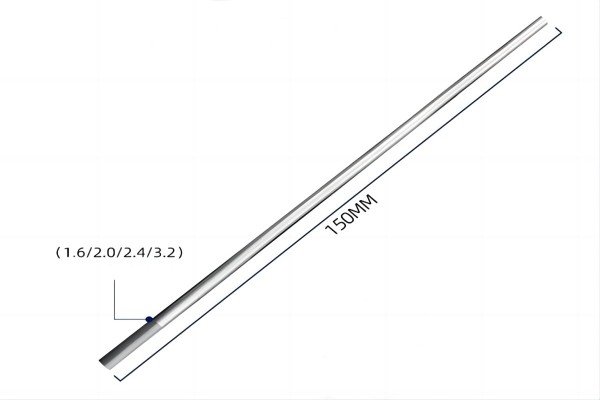
Ceriated tungsten electrodes are produced from tungsten with an addition of cerium oxide through powder metallurgy, rolling, and polishing processes. These are non-radioactive, refractory, or non-consumable metal electrode materials. Characterized by excellent arc initiation performance under low current conditions and maintaining a lower arc current, ceriated tungsten electrodes typically contain about 2% cerium oxide. The electrode diameters range from 0.5mm to 12.0mm, with lengths of 150mm or 175mm. Ceriated tungsten is used for welding pipelines, thin stainless steel plates, aluminum alloy products, and fine precision parts.
Chemical Composition
| Name | Dopant | Doping Amount | Tungsten Content % | Color Code |
| Ceriated Tungsten Electrodes | CeO2 | 1.80~2.20% | >97.5 | Grey |
Dimensions
| Grade | Diameter | Length |
| WC20 | 1.0mm | 150mm or 175mm or Customized |
| WC20 | 1.6mm | 150mm or 175mm or Customized |
| WC20 | 2.0mm | 150mm or 175mm or Customized |
| WC20 | 2.4mm | 150mm or 175mm or Customized |
| WC20 | 3.0mm | 150mm or 175mm or Customized |
| WC20 | 3.2mm | 150mm or 175mm or Customized |
| WC20 | 4.0mm | 150mm or 175mm or Customized |
| WC20 | 5.0mm | 150mm or 175mm or Customized |
| WC20 | 6.0mm | 150mm or 175mm or Customized |
| WC20 | 8.0mm | 150mm or 175mm or Customized |
| WC20 | 10.0mm | 150mm or 175mm or Customized |
| WC20 | 12.0mm | 150mm or 175mm or Customized |
Surface
All thoriated tungsten electrodes come with a default polished surface finish; we also offer tungsten electrodes with a black surface treatment.

(Polished)

(Black)
Advantage
.Non-radioactive and environmentally friendly.
.Low melting rate and high erosion resistance.
.Excellent weldability with a long service life.
.Easy arc initiation at low currents, stable arc column, and reliable re-ignition.
Disadvantages
They are only suitable for low current applications, and although the erosion resistance and arc initiation improve with increased cerium oxide content, the welding performance of ceriated tungsten electrodes gradually decreases over time with use.
What Is Thoriated Tungsten Used For?
Suitable for both DC and AC welding, especially effective for welding rail tracks and fine precision parts at low currents.
Mainly used for welding materials such as:
.Carbon steel
.Stainless steel
.Silicon bronze
.Copper
.Bronze
.Titanium
Tungsten Electrode Diameter and Corresponding Amperage Table
| Dia. | DC(A) | AC(A) | |||
| in | mm | Cathode contacted(-) | Anode contacted(+) | Asymmetric waveform | Symmetric waveform |
| 0.04" | 1 | 15-80 | 10-80 | 20-60 | |
| 1/16" | 1.6 | 60-150 | 10-18 | 50-120 | 40-100 |
| 0.079" | 2 | 100-200 | 12-20 | 70-160 | 60-130 |
| 3/32" | 2.4 | 150-250 | 15-25 | 80-200 | 80-150 |
| 1/8" | 3.2 | 220-350 | 20-35 | 150-270 | 120-200 |
| 5/32" | 4 | 350-500 | 35-50 | 220-350 | 170-260 |
| 3/16" | 4.8 | 420-650 | 45-65 | 240-420 | 220-340 |
| 1/4" | 6.4 | 600-900 | 65-100 | 360-560 | 250-450 |
Package
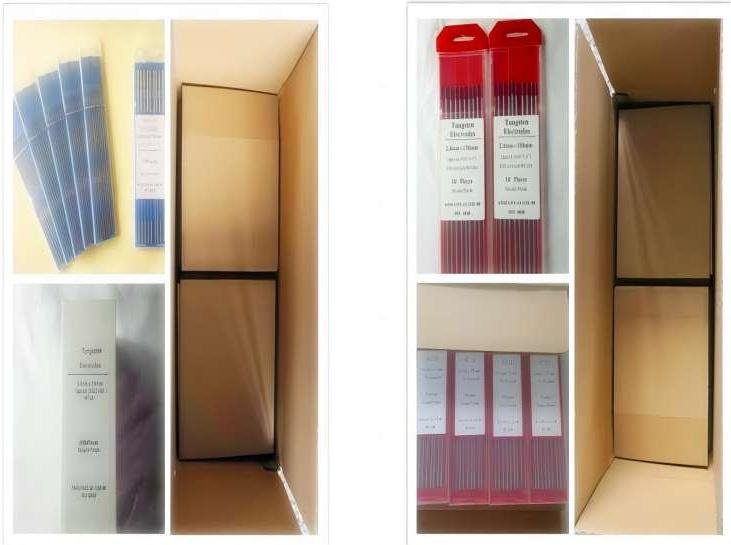
Retail Packaging: 10 pieces/plastic box

Wholesale Packaging:
.10 pieces/plastic box, 10 plastic boxes/carton, 10 cartons/case (Total: 1000 pieces/case)
.10 pieces/plastic box, 20 plastic boxes/carton, 6 cartons/case (Total: 1200 pieces/case)
Common Issues and Precautions
| Tungsten Electrode Common Issues | Causes | Corrective Measures |
| Cracking during welding process, Large spherical or bursting tips | (1) Hidden cracks in tungsten electrode. (2) Excessive current. (3) Insufficient argon gas purity, high water content,accelerating tungsten atom crystallization and rupture. (4) Uneven distribution of rare earth oxides. | (1) Cut off the tip and regrind or replace the tungsten electrode with a new one (note: do not knock it off, as knocking increases the risk of cracking). (2) Appropriately decrease the current. (3) Replace with higher purity argon gas. |
| Cracking during grinding | (1) Low temperature during tungsten electrode manufacturing process (2) Excessive compression during tungsten electrode processing | Manufacturer-related reasons, please replace with a new tungsten electrode. |
| Tungsten electrode turning white Difficult arc initiation | (1) Insufficient argon gas protection time during welding stoppage, resulting in oxidation film formation on tungsten needle tip (2) Tungsten needle contacts welding wire during welding process or oxidation film forms on base metal tip (3) Prolonged use of welding machine, loose zero line connection, unstable or excessive current | (1) Extend the argon gas protection appropriately during welding stoppage. (2) Ensure the tungsten needle does not touch the welding wire or base metal during welding. If accidentally touched, cut off the tip instead of knocking it off. (3) Check the welding machine's zero line connection. |
| Rapid tungsten electrode consumption | (1) Poor protection leading to tungsten electrode oxidation (2) Incorrect polarity connection between gun and welding machine (3) Overheating of clamp (4) Excessive small diameter of tungsten electrode (5) Tungsten electrode oxidation during welding stoppage | (1) Clean the nozzle, reduce the nozzle distance, and appropriately increase the argon gas flow rate. (2) Change the connection between the welding gun and the welding machine output. (3) Increase the diameter of the clamp. (4) Increase the diameter of the tungsten electrode. (5) Polish the electrode and extend the post-purge time. |
| Tungsten electrode dripping | (1) Excessive current (2) Tungsten electrode tip angle too sharp (3) Incorrect choice of tungsten electrode material | (1) Appropriately decrease the current. (2) Regrind the tip. (3) Select the tungsten electrode according to the base metal. |
| Unstable arc | (1) Oil contamination on the welded parts (2) Contamination of tungsten electrode (3) Excessive diameter of tungsten electrode (4) Excessive length of arc (5) Poorly ground tungsten electrode tip | (1) Perform proper pre-weld cleaning. (2) Remove contaminated parts. (3) Use tungsten electrodes and clamps of the correct size. (4) Adjust the nozzle distance. (5) Regrind the tungsten electrode tip to the appropriate cone angle size. |
| Tungsten Inclusion in TIG Welding | (1)Use a high-frequency oscillator and high-voltage pulse generator for arc initiation (2)Reduce current or increase tungsten electrode diameter to decrease electrode protrusion length (3)Replace any tungsten electrode with cracks | (1) Use high-frequency arc starting. (2) Reduce welding current or increase tungsten electrode diameter. (3) Replace tungsten electrodes with cracks." |
| Poor Gas Shielding | The argon gas purity is insufficient. | (1)Use argon gas with a purity of 99.99% (2)Ensure adequate pre-flow and post-flow time (3)Perform thorough cleaning before welding (4)Choose the correct gas flow rate/nozzle size/electrode protrusion length (5)There is sufficient pre-purge and post-purge time. |