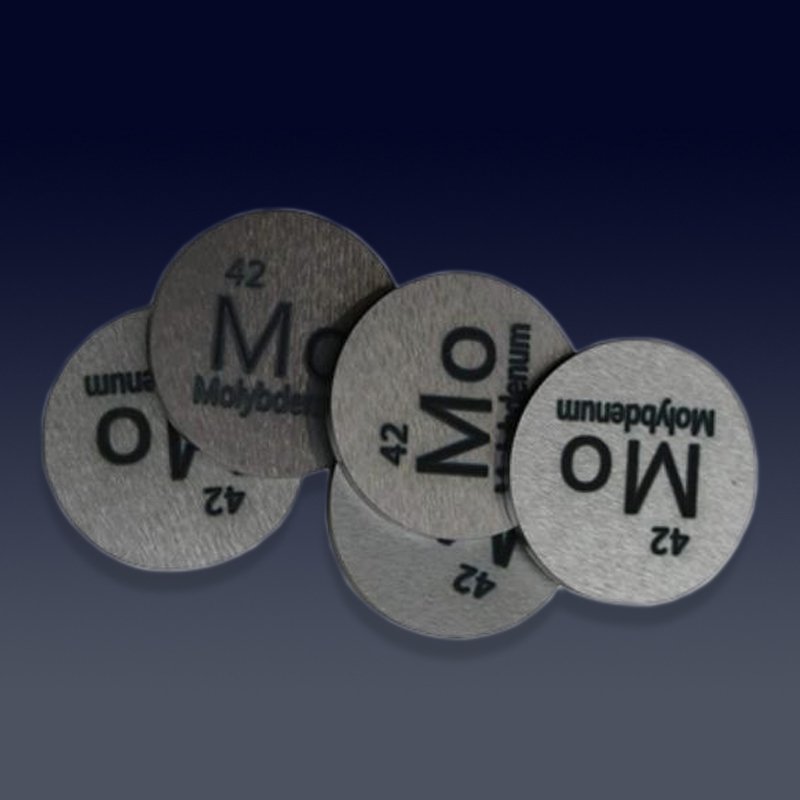
Molybdenum, symbolized as Mo, was discovered by Carl Wilhelm Scheele in 1778 and first isolated in 1781. This silvery-white metal, softer than tungsten, is renowned for its high melting point and corrosion resistance. Essential in steel alloys, molybdenum enhances strength at high temperatures, making it crucial in aerospace and automotive industries. It's also used in catalysts and pigments for high-pressure and temperature applications. Molybdenum is vital in plant nutrition, especially in alkaline soils, and plays a significant role in biological processes through its enzymes, highlighting its importance in both industrial applications and biological systems.

Molybdenum, much like tungsten, is one of the refractory metals. It does not possess the density of tungsten, yet it boasts a relatively high melting point and is somewhat easier to machine. Here are some key characteristics of molybdenum:
. High Melting Point: Molybdenum has an impressive melting point of 2623°C, making it highly stable in extreme heat.
. Moderate Density: It has a density of 10.28 g/cm³, which is less than tungsten but still significant.
. Strong Tensile Strength: Strong Tensile Strength: Known for its considerable strength, molybdenum resists deformation and breakage effectively.
. High Hardness: While not as hard as tungsten, molybdenum is still remarkably hard and resistant to wear.
. Low Thermal Expansion: Similar to tungsten, it expands minimally when heated, maintaining its form and stability.
. Good Electrical and Thermal Conductivity: Molybdenum conducts electricity and heat well, which is advantageous in electrical applications.
. Chemical Resistance: It exhibits resistance to many acids and alkalis, ensuring stability under various chemical conditions.
. Versatility in Forms: Molybdenum can be processed into various forms such as wire, powder, and solid, making it adaptable for diverse industrial applications.
Molybdenum Applications
. Steel and Metallurgy:
Widely used in steel metallurgy, molybdenum improves hardness, wear resistance, and corrosion resistance when added as an alloying element. Molybdenum alloy steels are extensively used in manufacturing cutting tools, bearings, springs, and automotive parts.
. Electronics and Semiconductor Industry:
.Molybdenum's excellent electrical conductivity and thermal stability make it a vital material in the electronics and semiconductor industries. It is used in manufacturing television tubes, vacuum tubes, semiconductor chips, and other components.
. Aerospace Industry:
.Molybdenum and its alloys are critical in aerospace for manufacturing high-temperature engine parts, spacecraft shells, and other heat-resistant components.
. Medical Field:
.Molybdenum plays a role in the medical field, particularly in radio pharmaceuticals. The isotope Molybdenum-99 is widely used for detecting and treating diseases like cancer and heart conditions.
. Chemical Industry:
.In the chemical industry, molybdenum is used in various processes. Sodium molybdate, a strong oxidizer, finds applications in chemical analysis, dyes, and catalysts.
. High Heat Components and Machining Tools:
.Molybdenum is used in high heat components, extrusion tools, electrodes for glass melting furnaces, thermal spray coatings, and metalworking tools. Its alloys are critical in aerospace components.
. Electrical Power Equipment Manufacturing:
As a primary material in electronics, molybdenum is used for filaments, lighting, electronic tube parts, microwave devices, medical electronic devices, internal components of X-ray tubes, X-ray flaw detectors, and integrated circuit components.
Molybdenum is a lustrous, silvery metal that, like tungsten, is seldom found in its pure form in nature, commonly occurring in minerals such as molybdenite (MoS2) and wulfenite (PbMoO4). With an atomic composition predominantly consisting of molybdenum, with a Mo content typically above 99.9%, pure molybdenum combines flexibility and ease of processing with significant hardness and strength, especially when alloyed or in the presence of impurities. Due to its high melting point, excellent thermal conductivity, and low thermal expansion, pure molybdenum is extensively used in demanding applications. These include electric light source components, aerospace and automotive industries for high-strength alloys and heat-resistant components, industrial furnaces where its high-temperature stability is crucial, and as sputtering targets in plasma coating processes, contributing to advancements in thin-film technologies.

Mo-La alloy is composed of the base metal molybdenum and lanthanum trioxide dispersed as fine particles within the matrix. The content of La2O3 in the alloy generally ranges from 0.5% to 5.0% (by mass). This unique microstructure remains stable even at temperatures up to 2000°C. Molybdenum possesses excellent high-temperature strength, creep resistance, low thermal expansion coefficient, good thermal conductivity, and corrosion resistance. Mo-La alloys are processed into high-temperature furnace components, such as vacuum furnace heat shields, sintering and annealing boats, wire drawing or evaporator coils.

TZM alloy, a high-performance molybdenum-based alloy, contains 0.50% titanium, 0.08% zirconium, and 0.02% carbon. It boasts a high melting point, significant strength, superior elastic modulus, low thermal expansion, low vapor pressure, excellent thermal and electrical conductivity, strong corrosion resistance, and robust high-temperature mechanical properties. These traits make it ideal for a wide range of applications including military, aerospace, and nuclear sectors. Utilized in components like engine valves, rocket nozzles, and electrical industry elements such as cathodes and semiconductors, TZM is also essential in producing heat-resistant materials for high-temperature furnaces and nuclear energy equipment.

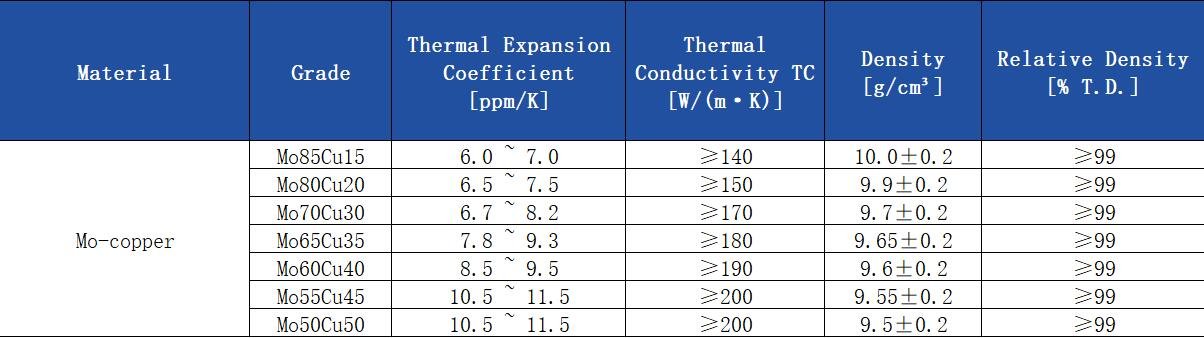
Molybdenum-copper alloys, pseudo-alloys composed of two immiscible metals, combine the properties of both molybdenum and copper. They offer high thermal conductivity, adjustable low thermal expansion, non-magnetic nature, low gas content, excellent vacuum performance, good machinability, and special high-temperature capabilities. Their applications are diverse, including vacuum contacts, conductive cooling components, instrument parts, and high-temperature sections of rockets and missiles at slightly lower temperatures. Octametals employs isostatic pressing to produce large, irregular products, with molding and extrusion for sheets, rods, tubes, and small items in various shapes. Rolling techniques yield plates and multilayer composites, with the technology reaching leading levels both domestically and internationally. With the electronic industry's growth, the demand for molybdenum-copper sheets for heat sinks, typically made from infiltrated blanks rolled into the desired thin plates, is surging.
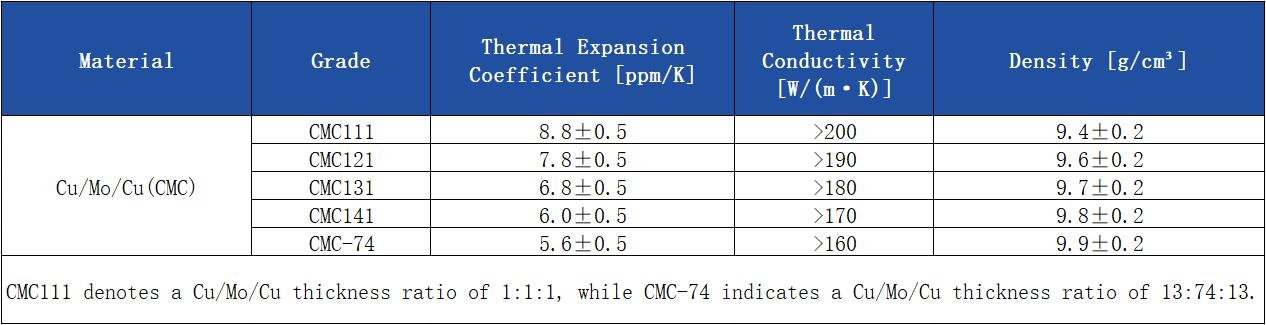
Copper/Molybdenum/Copper, also known as CMC, is a composite material with a "sandwich" structure, featuring a molybdenum metal core clad on both sides with pure copper. The properties of CMC can be tuned by adjusting the thickness ratio of copper to molybdenum, providing high thermal conductivity, strength, and a low coefficient of thermal expansion. It is used in applications such as RF tube cases, multilayer ceramic circuits, and as heat sinks and cooling bases for power devices.
Copper/Molybdenum-Copper/Copper, abbreviated as CPC (Cu/MoCu(Pressed)/Cu), is a composite material with a "sandwich" structure featuring a metal molybdenum-copper core clad on both sides with pure copper. Although CPC has a slightly higher coefficient of thermal expansion compared to CMC, it offers stronger bonding between copper and molybdenum-copper, higher thermal conductivity, and superior reliability and heat dissipation. Common layer thickness ratios for CPC include 1:4:1, 2:3:2, and 1:1:1, but adjustments to layer thickness can be made as needed to optimize performance.

+8615302000357
widitmetals@gmail.com
NO11. Liyu Industrial Park,Tian Yuan,
ZhuZhou,Hunan 412007