
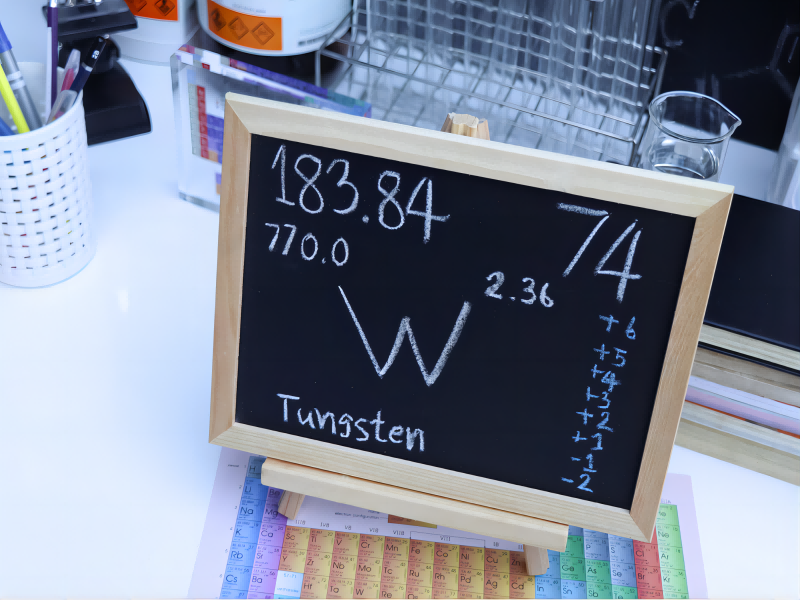




Tungsten, a lustrous, grayish-white metal, boasts the highest melting point of any metal at 3,422°C. When polished, it maintains a silver-like shine. Renowned for its remarkable hardness and density, tungsten finds extensive use in a variety of applications, ranging from incandescent light bulb filaments to cutting tools and armor-piercing ammunition. Its unique properties also make it invaluable in the electronics and aerospace industries for its high-temperature stability and resistance to thermal expansion.
Name: Tungsten
The Electron Configuration For Tungsten Is:
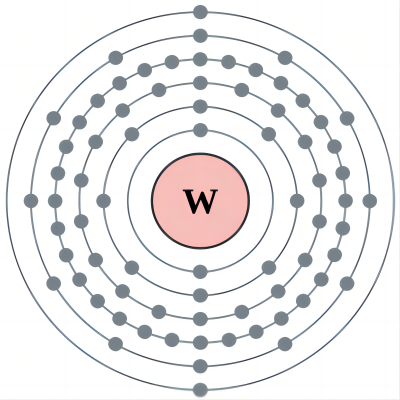
Outer Electron Distribution: Electron Configuration: 
Property | Value |
Atomic Number | 74 |
Atomic Weight | 183.86 |
Group Number | 6 |
CAS Registry Number | 7440-33-7 |
Wire Atomic Volume | 9.53 |
Lattice Type | Body Centered Cube |
Lattice Constant at 20°C, Angstroms | 3.1585 |
Natural Isotopes | W-184 (30.64% natural abundance), W-186 (28.43%), W-182 (26.50%), W-183 (14.31%), W-180 (0.12%) |
Density at 20°C (gm/cc) | 19.3 |
Density at 20°C (lb./cu. in.) | 0.697 |
Melting Point °C | 3410 |
Boiling Point °C | 5530 |
Linear Coefficient of Expansion per °C | 4.3 x 10^-6 |
Thermal Conductivity at 20 °C (cal/cm/°C/sec) | 0.4 |
Specific Heat @ 20 °C (cal/gram/°C) | 0.032 |
Electronegativity (eV) Pauling | 2.36 |
Electronegativity (eV) Sanderson | 0.98 |
Electronegativity (eV) Alfred Rochow | 1.4 |
Electrical Conductivity, % IACS | 31 |
Electrical Resistivity @ 20°C (microhm-cm) | 5.5 |
Electrical Resistivity @ 227°C (microhm-cm) | 10.5 |
Electrical Resistivity @ 727°C (microhm-cm) | 24.3 |
Electrical Resistivity @ 1727°C (microhm-cm) | 55.7 |
Electrical Resistivity @ 2727°C (microhm-cm) | 90.4 |
Electrical Resistivity @ 3227°C (microhm-cm) | 108.5 |
Temperature Coefficient of Electrical Resistivity Per °C (0-100 °C) | 0.0046 |
Tensile Strength @ Room Temperature, psi | 100,000 - 500,000 |
Tensile Strength @ 500 °C, psi | 75,000 - 200,000 |
Tensile Strength @ 1000 °C, psi | 50,000 - 75,000 |
Poisson's Ratio | 0.284 |
Hardness (Mineral) | 7.5 |
Hardness (Vickers) | 343 |
Hardness (Brinell) | 2570 |
Reflectivity | 62% |
Total Emissivity @ 1500 °C | 0.23 |
Total Emissivity @ 2000 °C | 0.28 |
Working Temperature, °C | <1700 |
Recrystallization Temperature, °C | 1300 - 1500 |
Color | Grayish white |
Valence | 6 |
Crystal Structure | Body-centered cubic (BCC) |
Common Oxidation States | 0, +2, +3, +4, +5, +6 |
Discovery Year | 1781 |
Discovered By | Carl Wilhelm Scheele |
High Tensile Modulus | 411 GPa |
Chemical Symbol | W |
Atomic Radius | 135 pm |
Ionization Energy | 7.864 eV |
Thermal Expansion Coefficient | 4.5 m/m-K |
Magnetic Susceptibility | 6.8 10^-6 cm^3/mol |
Thermal Neutron Cross Section | 19.2 barns |
Electrical Conductivity | High |
Luster | Metallic |
Color | Steel-gray to tin-white |
Chemical Stability | Highly resistant to corrosion |
Resistance to Acids | Resistant to most mineral acids |
Cross Section for Thermal Neutrons | High |
Radioactive Isotopes | Several, some used in medical applications |
Toxicity | Low for elemental tungsten |
Environmental Impact | Low, but mining impacts need management |
Workability | Can be worked at high temperatures |
Sintering Behavior | Can be sintered |
Abundance | Not rare, but high-grade ore is less common |
Recycling | Tungsten is recyclable |
Common Compounds | Tungsten carbide (WC), Tungsten hexafluoride (WF6), Tungsten disulfide (WS2) |
Major Uses | Filaments for light bulbs, electron and X-ray sources, rocket engine nozzles |
Tungsten's unique physical and chemical properties make it an indispensable material in a multitude of industries, from electronics to aerospace. Its versatility is showcased in its varied applications, underlining its crucial role in both everyday technology and advanced scientific endeavors. Tungsten's significance in modern industry and technology is as undeniable as it is varied, marking it as a key element in shaping the future of innovation.